
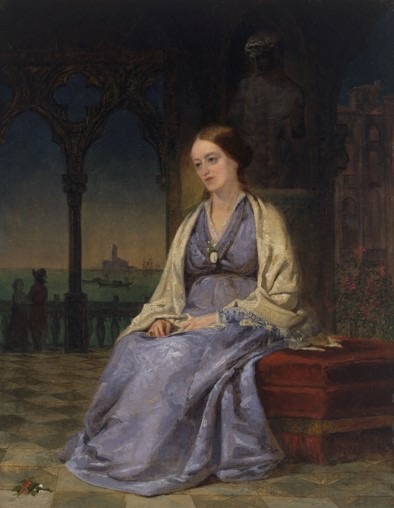
In a world where men claimed to have all the answers, Margaret Fuller made it her mission to ask all the right questions. “How came I here?” she wrote as a young adult. “How is it that I seem to be this Margaret Fuller? What does it mean? What shall I do about it?” She was never more than an occasional visitor in Concord, and that for only seven years or so, but this town was electrified by her presence.
She was born Sarah Margaret Fuller in 1810, in Cambridge, and her Harvard-educated father raised her to be his intellectual peer. She sought role models for the life she aspired to–educated, independent women. Biographer Megan Marshall writes that she “never rested till she had found the bottom of every mind—till she had satisfied herself of its capacity and currents—measuring it with her sure line.” She read the work of women authors, including Germaine de Staël’s The Influence of Literature upon Society. She learned German in three months, and especially loved Goethe: “He comprehends every feeling I have ever had so perfectly.”
“I will make up my mind to teach,” she announced as she turned 26. She got a job at Bronson Alcott’s progressive Temple School, but Alcott couldn’t afford to pay her. So in 1839 Margaret advertised for women “desirous to answer the great questions: What were we born to do? How shall we do it?” She offered a a 13-week course of “Conversations” for $10. By the time the first series concluded, her group was analyzing the role of women in society.
In 1840 she became the first editor of the Transcendentalists’ journal, The Dial. She set a high standard of criticism, and made sure to include work by women writers. It was during this time that she visited at the Concord home of Ralph Waldo Emerson and with Nathaniel and Sophia Hawthorne at the Old Manse.
Like the Temple School, The Dial didn’t pay her, so she resigned as editor, but continued to contribute essays. Horace Greeley, publisher of the New York Tribune, proposed expanding one of her essays into a book. In 1845 she published that book as Woman in the Nineteenth Century. “We would have every path laid open to Woman as freely as to Man,” she wrote. “If you ask me what offices they may fill, I reply—any . . . let them be sea-captains, if you will.”
In 1846, Greeley sent her to Europe as a foreign correspondent—the first American woman to hold such a post. In Rome at the time of the ill-fated revolution to unify Italy, she became a war correspondent. Her life was changed forever when she fell in love with a young Italian, Giovanni Ossoli. “I have not been so well since I was a child, nor so happy ever,” she wrote. They welcomed a son, Angelo, in 1848. After the Roman Republic fell she decided to return to America with Giovanni and their son. They booked passage on a merchant ship, but on July 19, 1850, their ship was wrecked within sight of Fire Island, New York. Margaret and Giovanni were lost, and only the drowned body of their son was recovered.
Margaret Fuller was only 40 years old when she died, but in her short life she made a name for herself as one of America’s most respected public intellectuals. Today she is remembered as an educator, author, editor, critic, and journalist, and Woman in the Nineteenth Century is considered the founding text of American feminism.
Image: Margaret Fuller, portrait by Thomas Hicks (1848). National Portrait Gallery, Smithsonian Institution.
 History Lives